
Rev. Jackson understood something many still resist: civil rights do not end at voting booths or courtrooms. They extend into purchasing decisions, supply chains, boardrooms, and balance sheets. Economic justice was never ancillary to his work—it was foundational.
Our Pitch to Rev. Jackson — 2006
In 2006, Creative Investment Research actively sought to develop, alongside Rev. Jackson and Operation PUSH, what we believed was a next-generation framework for corporate accountability. This effort is documented in contemporaneous correspondence from that period .
At the center of our work was a simple but then-radical proposition:
Corporations that benefit from African American consumer spending should be explicitly accountable—measured, ranked, and rewarded or penalized—based on their treatment of African American stakeholders.
This was not rhetorical diversity. It was quantified economic accountability.
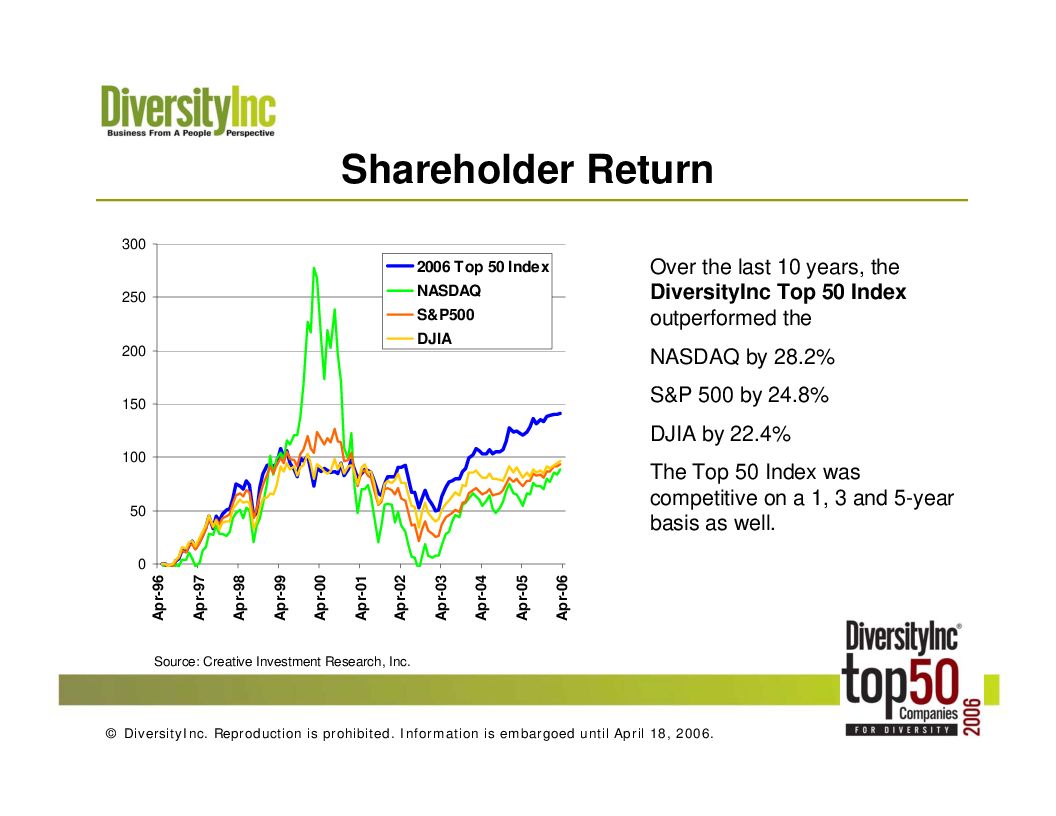
We proposed a Corporate Diversity and Social Performance Report Card, grounded in capital-markets research, consumer-spending data, and measurable outcomes. The concept is visually summarized in our 2006 Diversity Investing Index and framework, which laid out how civil-rights objectives could be operationalized through investment analysis rather than voluntary pledges or marketing campaigns.¹
Beyond Advocacy: Capital as Enforcement
Crucially, this work did not stop at measurement. We proposed the creation of investable products that would allow Black investors and allied institutions to act on the data.
That effort culminated in the first investment portfolio devoted explicitly to diversity performance—a portfolio designed to channel capital toward companies demonstrating measurable commitments to minority advancement, supplier diversity, governance inclusion, and community impact.²
This approach treated capital as enforcement, not charity. Markets, not speeches, would (we hoped) discipline corporate behavior. Others, notably the State Street Gender Diversity ETF and the NAACP Minority Empowerment ETF have tried to mimic our work. Their efforts have, so far, fallen short.
Had Rev. Jackson been able to fully engage with us at that moment—had the broader civil-rights and CSR ecosystem embraced investment-based accountability rather than voluntary disclosure—the entire trajectory of corporate social responsibility might have unfolded very differently.
Would we have avoided Enron?
The subprime mortgage crisis?
The parade of post-crisis diversity pledges followed by minimal change?
Maybe.
Maybe not.
We will never know.
What we do know is that Corporate Social Responsibility (CSR), as it ultimately evolved, became too performative, too easily captured by public-relations departments, and too disconnected from capital allocation. The chance to hard-wire civil-rights values directly into shareholder discipline, consumer power, and portfolio construction was real—and briefly within reach.
The Power of His Voice
Whatever paths were not taken in markets, Rev. Jackson’s voice in politics remains unmatched.
His Democratic National Convention speeches in 1984 and 1988 remain, to us, the best examples of positive, aspirational, and morally grounded political speechmaking in U.S. history. They were expansive rather than divisive—rooted in coalition, dignity, and shared economic destiny.
Those speeches articulated a vision of justice that naturally extended into economics, even if institutions later proved unwilling to follow through.
Continuity Through the Next Generation
We also note that we have appeared on panels with his son, Jonathan Jackson, continuing conversations about economic inclusion, market structure, and accountability. That continuity matters. Movements endure not by memory alone, but by adaptation.
Final Word
Rev. Jesse Jackson helped force America to confront an enduring truth:
Civil rights without economic power is incomplete freedom.
History did not unfold exactly as it might have. Still, his insistence on moral clarity, economic dignity, and accountability shaped generations of activists, policymakers, and market reformers—including us.
We honor his legacy not with nostalgia, but with continued work to align capital with conscience, markets with justice, and promises with measurable results.
References
¹ Creative Investment Research, Diversity Investing Framework (2006), visual summary:
https://www.creativeinvest.com/DiversityInvesting2006CIR.jpg
² Creative Investment Research, First Investing Portfolio Devoted to Diversity:
https://www.creativeinvest.com/FirstInvestingPortfolioDevotedtoDiversity.pdf